Business
The TopRanked.io Weekly Digest: What’s Hot in Affiliate Marketing [K4G Affiliates Review]
Hot take: journalism’s not dead, and there’s a big opportunity for affiliates who realize this. Now, sure, it is dead if, by “journalism” you mean “legacy media”. But, look a little wider, and you’ll see it’s alive and kicking. Big time. All you got to do is monetize it. And to help you with that, we’ve got a quick little K4G Affiliates review you should definitely check out while you’re here.


We independently review products to bring you the best of the best. When you click a K4G Affiliates link, we may earn a small commission.
Hey there, affiliates.
If I say the letter “G”, what do you think of? Lemme guess. It’s probably got something to do with “OG”, right?

Personally, I think of K4G. K4G Affiliates, that is.
TopRanked.io Affiliate Partner Program of the Week — K4G Affiliates
This week, K4G Affiliates is our pick of the bunch from our top affiliate programs.
And here’s why K4G Affiliates might just be a top pick for you, too.

K4G Affiliates — The Product
K4G Affiliates, at its core, is mostly about selling a competitor to something like Steam.
You know, like video games and stuff.
What sets K4G Affiliates apart from Steam, however, is its focus on something that should prove very, very irresistible to people (and hence, it’s great for conversions).
With K4G Affiliates, you’re not just selling video games. You’re selling discount video games. As in, the same exact piece of software, only cheaper.
Here’s an example I pulled from one of the pages you might send people to once you’re K4G Affiliates member. On the left, you’ve got the page anyone using your K4G Affiliates links will see. And on the right, you’ve got what anyone looking at Steam will see.

Big difference, right?
And that’s the basic value proposition that will make your K4G Affiliates links convert like hotcakes… so long as you get them in front of the right audience.
But that part’s on you. And we’re not here to talk about you. So let’s move onto something else that’s on K4G Affiliates.
K4G Affiliates — The Commissions
With K4G Affiliates, the commissions are pretty simple. You get a 5% cut of any sales you refer through your K4G Affiliates links.
Nice and simple. Just how we like it.
Now, as for whether that 5% rate paid by K4G Affiliates is any good… the answer is a strong yes.
For starters, this one’s a volume game. With K4G Affiliates, you’re selling discount games, not lifetime memberships to some super-premium club. (I.e., you’re selling a product that converts hard and fast.)
So as long as you’ve got some traffic, you’re going to get the volume you need to make those K4G Affiliates links work properly for you.
Second, just in case you were still not sure about that 5% rate K4G Affiliates will pay you, go take a look at what everyone else is paying.
Spoiler alert — it’s not great. Amazon Associates, for example, is only paying 2% on video games.
That’s literally 60% less than K4G Affiliates is paying.
Now ask yourself who you’d rather work with. My answer’s simple — K4G Affiliates.
K4G Affiliates — Next Steps
K4G Affiliates — it’s a strong offering. You’ve got a value proposition that will convert massively. And you’ve got industry-leading commission rates.
Now, I know that might not be enough info for some of you. Lucky for you, if you take a look over on TopRanked.io, we do have a more detailed K4G Affiliates review.
And as for the rest of you… Well, you know what to do. Head here to sign up with K4G Affiliates today.
Affiliate News Takeaways
This week, I ran into this article.
The tl;dr goes a little like this:
- Journalism is dying
- A Stanford grad is having success in journalism
- The author asks the profound question — ‘Oh, wow, does this mean journalism isn’t dying?’
That’s basically it. Some kid does journalism. The author turns it into a “profound” question.

But then I thought, “Hold on a second, maybe there might be an opportunity here.”
Think about it. We might just have the following elements.
- A market which everyone else thinks is “dead.”
- Someone showing that it’s not “dead.”
- But most people still want to think that it is “dead.”
And that’s what we in affiliate land like to call a low-competition niche.
But, of course, there’s a good chance I’m getting ahead of myself here. Just because one kid’s suddenly enjoying some success as a journalist, doesn’t mean the entire industry’s coming back to life, does it?
No, of course it doesn’t. If it did, that would mean that basically any long-dead craft where a handful of people still carve out a living is making a comeback. And, let’s face it, it’s not like every town’s suddenly going to need or want a blacksmith, is it?

But then I thought about it some more. And I realized that maybe there’s something deeper going on here.
That’s what led me to ask the following question: “Did journalism ever really die, or do we just think it died?”
Now, don’t get me wrong here. The era where buttoned-up columnists and perfectly coiffed news presenters were in high demand is long gone.
That more or less definitively went the way of the dodo when Buzzfeed was still a thing.

But that’s not what I’m talking about when I say “journalism” here.
What I’m actually talking about is “real journalism.”
What do I mean here?
Well, here’s a multiple-choice question to help you see what I mean here.
Q: What of the following most closely resembles a journalist’s actual job?
- Option A: Sitting in a glass-walled conference room with a dying plant while discussing whether Q4 ad revenue justifies covering the city council budget before returning to a desk to sip stale coffee while waiting for a Slack message from legal to greenlight a 300-word rewrite of a press release.
- Option B: Obsessively dig through court filings at 2 am, cross-referencing 17 contradictory sources, DMing a whistleblower from a burner account, and then making an attempt to explain to the public what the hell is going on.
If your idea of journalism is option A, then yeah, I guess all the pundits are correct. Journalism is 100% dead, if not dying.
But, if your idea of journalism is more like option B, then I got news for you — I got a hunch that journalism never died.
In fact, I’d almost be willing to bet that journalism’s actually doing quite well.
To show what I mean here, let me give you an example of some work that I would call “real journalism”.

Now, first things first. If you’re reading this, then you probably already know what that video is about. If you don’t, the long-story-cut-short summary goes like this: Popular browser extension Honey was stealing from affiliates like you and me.
So now we’ve got an example in place, what do you think? Do you think this satisfies the criteria of “real journalism”?
I think it does. The guy did a proper investigation and uncovered a bunch of stuff. Then he put it together in a nice little report that the general public could understand.
Then, he got 18 million people to watch it (and counting).
Now, let me put that number into perspective for you.
- That video’s been up for 11 months (a little under a year).
- As a reminder, that video’s garnered 18 million views in that time.
- That’s about the same number of visits/views a low-/mid-grade “commercial” news outlet will get in a month (e.g., MSNBC got 18.3M in October)
In other words, one random YouTube creator puts out one video and picks up 18 million views.
Meanwhile, it takes an entire mid-grade news team (with accounting, legal, and all of its other overhead) cranking out hundreds of pieces of news content per month… just to get the same amount of views.
And it’s not like that Honey video was some sort of anomaly. We see this sort of content everywhere now. So-called “creators” are cranking out real journalism that puts the big outlets to shame, and racking up decent audiences with it.
And it’s not just “creators”, either. So-called “real journalists” (in the traditional sense) are going down this path, too.
Take, for instance, former Vox guy Johnny Harris.

He’s got 7.3 million subs and not a single video with fewer than a million views.
The New York Times, by contrast, has 11.8 million subscribers… and I’m willing to bet 90% of its articles never even get read by more than a couple thousand people.
Or, what if we follow up on some of the journalists who used to work for some of the real “crash-and-burn” outlets from recent years. You know, the ones that really went up in flames, like BuzzFeed and Vice.
Well, here’s one example: 404 Media. Founded by a handful of ex-Vice reporters — apparently they’d hit “sustainable” within one year of launch.
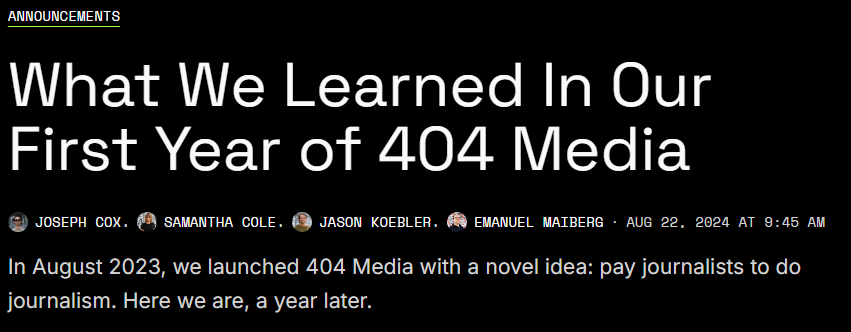
Or here’s another example, this time from an ex-BuzzFeed guy, Ryan Broderick. I don’t have numbers here. But, he started that little newsletter solo. Now, he’s got a small team working full-time, so presumably, it’s profitable.
And then, there are the thousands of “creators” who are pumping out “real journalism” in just about every niche, across YouTube, newsletters, websites, TikToks, Podcasts, and countless other platforms.
All while gaining real audiences.
And I think, if we survey this landscape, we start to see why journalism actually died.
Most traditional media was little more than a hodgepodge of milktoast reporting about stuff nobody cared about, mixed in with the occasional massive “scoop”/serious bit of investigative reporting just to keep audience numbers up.
I.e., 99% of their content is stuff nobody really cared that much about.
Meanwhile, the “creators” who are actually doing “real journalism” are carving out decent audiences in really niche spaces. I.e., 99% of their content is stuff their audience actually cares about.
Think about it. Where do you get most of your news these days?
Regular old “news” outlets? Or from a random bunch of newsletters, podcasts, YouTubers, and other “creators” that you never really thought of as journalists, despite the fact that what they’re actually doing is…
…journalism.
And people thought journalism was dead.
Takeaway
Hear me out, because some of you are going to think I’m crazy.
I reckon more affiliates should start getting into journalism.
Why?
- Because clearly, it’s not dead. It just shifted. It was concentrated in the hands of a bunch of legacy media outlets. Now it’s fractured into hundreds of thousands of niche creators (and some former journalists that went independent).
- Because some journalism is insanely easy to crank out (read on for an idea you can build this weekend and monetize by Monday).
- And because it’s a great way to hold onto an audience.
Here, let me give you an example of what you could totally start doing this weekend.
- Go start a Substack.
- Make it about gaming.
- Collect a bunch of data sources you can throw into an AI. E.g.,
- Industry press releases
- The Steam web API
- A YouTube subtitle scraper.
- Etc.
- Come up with a bunch of reports you can churn out with that data.
And here’s a concrete example of how to put it together.
Let’s say you pick up on a press release about a sequel to some game.
You can scrape Steam for data about the original version(s) of that game.
You can scrape YouTube and grab the subtitles for videos mentioning that game.
You can feed all that data into an AI and say, “Here, write me a report using all of this. Include details about the original(s) —, actual downloads, popularity, etc., etc., etc. — tell me about how people reviewed the game, what they expect in sequels, etc.”
You know, basically just get it to write up all the data you scraped.
And just like that, you’re now doing journalism that a handful of game nerds might actually follow you for.
Now, obviously, they might not be all that willing to become a paid subscriber to your newsletter if all you’re doing is pretty basic surface-level journalism like this.
But that’s fine. It’s costing you basically nothing in time (since you’re going to do this all with AI agents). And, if you’re at least pulling together data from multiple sources, you’re presumably saving them time.
And that’s probably enough value to earn you a few clicks on your affiliate links.
As to where you’ll get those links from, might I suggest K4G Affiliates?
Closing Thought
Needing a closing thought but being out of inspiration this week, I went to one of those websites that list popular quotes.
That’s when I landed on this weird juxtaposition in one list.
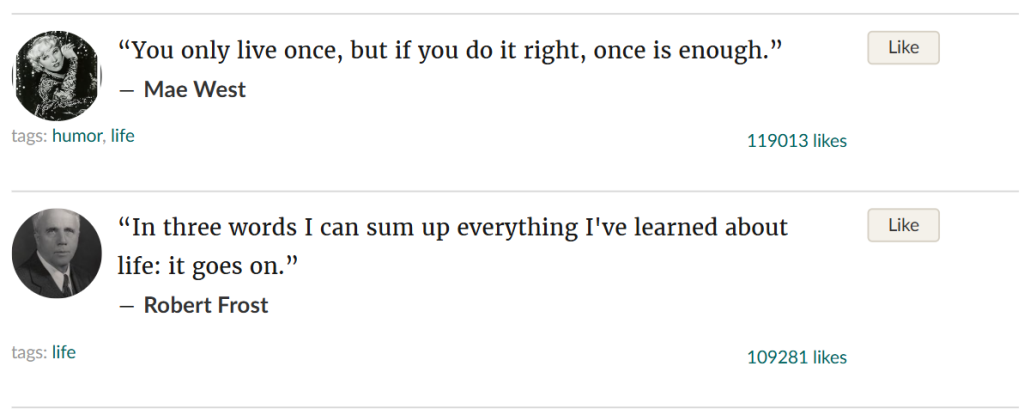
Now, at first, I had a slight confusion here. “Hmm, life ends, but it also goes on…”
But then, I thought about it like this.
The second quote seems to be describing a sorta “physics” of life. A system that doesn’t pause, or negotiate, or even care. It just keeps… running.
The first quote, however, seems to be describing a strategy. A sort of “it’s your approach that counts” rallying cry that’s meant to make you realize you need to play this game deliberately.
So, now let’s put them together, and what do we get?
Something along the lines of, “Life won’t stop for you. What you do during it is the only part that’s yours.”
And just in case you need some ideas on what to do with it… have you heard about K4G Affiliates?
__
(Featured image by SevenStorm JUHASZIMRUS via Pexels)
DISCLAIMER: This article was written by a third party contributor and does not reflect the opinion of Born2Invest, its management, staff or its associates. Please review our disclaimer for more information.
This article may include forward-looking statements. These forward-looking statements generally are identified by the words “believe,” “project,” “estimate,” “become,” “plan,” “will,” and similar expressions. These forward-looking statements involve known and unknown risks as well as uncertainties, including those discussed in the following cautionary statements and elsewhere in this article and on this site. Although the Company may believe that its expectations are based on reasonable assumptions, the actual results that the Company may achieve may differ materially from any forward-looking statements, which reflect the opinions of the management of the Company only as of the date hereof. Additionally, please make sure to read these important disclosures.




Crypto Markets Volatile as Bitcoin Hovers, Solana Eyes AI Integration
Crypto markets remain volatile amid the Iran war, with Bitcoin near $70,000 and ETF inflows improving outlook. Ethereum faces declines...


Crowdfunding Evolves into Core Financial Infrastructure in Europe
European crowdfunding has matured under ECSPR, growing to 254 platforms by 2026 despite operational challenges. Key shifts include debates on...


DZ Bank Pioneers Blockchain Bond Issuance, Advancing Tokenized Finance
DZ Bank issued a bond via a public blockchain, marking a major step in tokenized bank bonds. The move could...


Ridemovi Secures Financing to Drive European Expansion and Sustainable Mobility Growth
Ridemovi, a Milan-based micromobility company operating bike, e-bike, and scooter sharing in Italy and Spain, secured bank financing led by...


Bank Al-Maghrib Launches Reforms to Boost Credit via Non-Performing Loan Market
Bank Al-Maghrib is advancing a secondary market for non-performing loans to free bank financing and boost credit. With Moroccan NPLs...
 |
|
 |  |
 |
|
-

 Business6 days ago
The TopRanked.io Weekly Digest: What’s Hot in Affiliate Marketing [NiftyPM Affiliate Program Review]
-

 Biotech2 weeks ago
Novo Nordisk: Stable Growth and Defensive Biotech Stock for DACH Investors in 2026
-
 Impact Investing9 hours ago
Ridemovi Secures Financing to Drive European Expansion and Sustainable Mobility Growth
-

 Impact Investing1 week ago
Antarctica Warming Reshapes Global Atmospheric Circulation