Business
The TopRanked.io Weekly Digest: What’s Hot in Affiliate Marketing [Super Partners Review]
People are stealing your hard-earned affiliate commissions. And no, I’m not exaggerating. This week, we look at how they’re doing it (hint: Honey’s the big one here, but they’re not the only ones) and what you can do to fight back. And just for good measure, we’re also going to take a look at Super Partners: a great affiliate program working with top iGaming brands and paying great commissions.


Quick Disclosure: We’re about to tell you how Super Partners is pretty great. And we really mean it. Just know that if you click on a Super Partners link, we may earn a small commission. Your choice.
Hey there, affiliates.
I know this is a day late… but here goes anyway.

Now let’s get down to business.
TopRanked Affiliate Program of the Week — Super Partners (Formerly Buffalo Partners)
If you’ve been reading our affiliate digests for a while now, then there’s a good chance you’ve already seen a Buffalo Partners review in the past.
What you might not know, however, is that Buffalo Partners is now known as Super Partners.
Same basic program. Same great brands. Just with the new Super Partners name.
So let’s take a close look at Super Partners.

Super Partners — The Product
At its core, Super Partners is an iGaming affiliate program.
What sets Super Partners apart from most iGaming affiliate programs, however, are two key points:
- The number of brands you can work with as a Super Partners affiliate.
- The quality of the brands you can work with as a Super Partners affiliate.
Take, for instance, Betway.
Ever heard of Betway? (Of course you have — rhetorical question…).
Well, guess what — you can work with Betway when you sign up with Super Partners.
In fact, as a Super Partners affiliate, you can also work with Royal Vegas, Spin Casino, Euro Palace, and 10 other top-quality iGaming brands.
All you need is a single Super Partners account and some way of promoting.
So now you know the product side of Super Partners, let’s get to the commissions part.
Super Partners — The Commissions
As with most iGaming affiliate programs, the default plan at Super Partners is a good ol’ rev share deal.
Here’s what Super Partners offers:
| Referred Players | Rev Share % |
| 1-10 | 25% |
| 11-40 | 30% |
| 41-100 | 35% |
| 101+ | 40% |
Oh, and as a nice little kicker, Super Partners will pay you a healthy 50% during your first month as an affiliate in the Super Partners program.
Now, as with all things in life, there is a small downside with Super Partners. However, the downside here is much better than most.
Tl;dr — if you don’t refer any new players in a 6-month period, Super Partners will drop your commission rate down to 20%.
Fortunately, that’s not too bad (plenty of other programs just cut your commission full stop). And the best part is, as soon as you start driving traffic again, Super Partners will bump your commission rate back up again.
Super Partners — Next Steps
That’s enough about Super Partners for now. If you want to know more, then why not head over to TopRanked.io for our full Super Partners affiliate program review? (PS: Yes, we’ve still got Super Partners listed as Buffalo Partners… but don’t worry, it’s still the same basic program.)
Alternatively, if you know a good thing when you see it and want to get started right now, then head here to sign up with Super Partners today.
News Takeaways
A couple of weeks ago, we put together an issue about journalism.
Specifically, it was our K4G Affiliates Review edition. And in it, we looked at the idea that journalism isn’t actually dead (and how this creates opportunities for affiliates…).
It’s just that the market/landscape/definition is changing.

Anyway, in that edition, we pulled in a couple of examples of this “new era” of journalism. One of which was particularly pertinent to affiliates like you and me. It was this:

So, why am I bringing up an old edition again this week?
Well, almost as if by coincidence, “MegaLag” (the screen name of the guy behind the Honey investigation) dropped a new installment.

Now, for those of you who somehow missed this, there’s a lot of material and various “issues” with Honey that MegaLag covers. But, for you affiliates out there, here are the main points you should be aware of:
- Honey is a “discount code” browser extension that claims to find users the best discount codes to apply at checkout of online stores.
- To do this, Honey pops up a notification telling the user what it found (including if it didn’t find any discount codes).
- When users interact with this notification, Honey loads their own affiliate links in the background in a way that’s invisible to the end user.
- As such, a new affiliate cookie gets written into the user’s browser.
- When this happens, Honey now gets the affiliate commissions for that sale (if last-click attribution, which most programs are…), even if it was another affiliate that actually generated the traffic in the first place.
So, why should you care about this as an affiliate?
Read that last point about last-click attribution again.
Basically, in plain language, if any of your referrals have Honey installed, Honey is stealing your affiliate commissions.
Simple as that.
And don’t get sidetracked by the fact that the original reporting heavily focused on YouTube creators specifically…
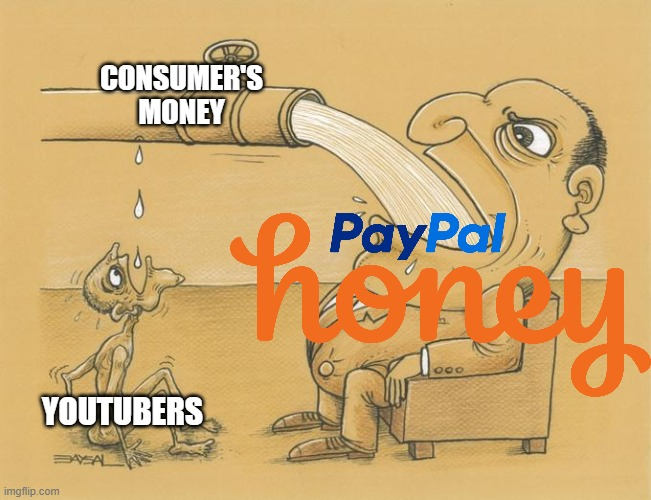
Honey doesn’t discriminate (nor can it) between affiliate cookies left by YouTube creators’ affiliate links and those left by any other affiliate links. (And besides, if you were running an affiliate commission-stealing operation, why would you limit yourself to stealing from one specific type of affiliate?)
And that means, even if you’re running an operation that’s the polar opposite of a YouTube creator, Honey is still stealing your commissions.
Here, let me give you a concrete example of who else Honey is stealing from:
- Imagine you’re running an ad campaign to drive traffic through your affiliate links.
- User sees your ad, clicks on it, and thinks, “hmmm, nice, I wanna buy.”
- So the user proceeds to the checkout page, and they’re about to buy.
- By rights, you’re about to earn yourself a nice little affiliate commission.
- But now, Honey pops up to tell the user, “Sorry, bro, no discounts available.”
- User clicks to dismiss the message and, as they do, Honey loads their own affiliate links in the background.
- When this happens, Honey’s affiliate cookie gets dropped in the user’s browser (thus overwriting yours).
- User checks out.
- Honey gets what should have been your commission.
- You get nothing.
And here’s an example of one of Honey’s “affiliate links”.
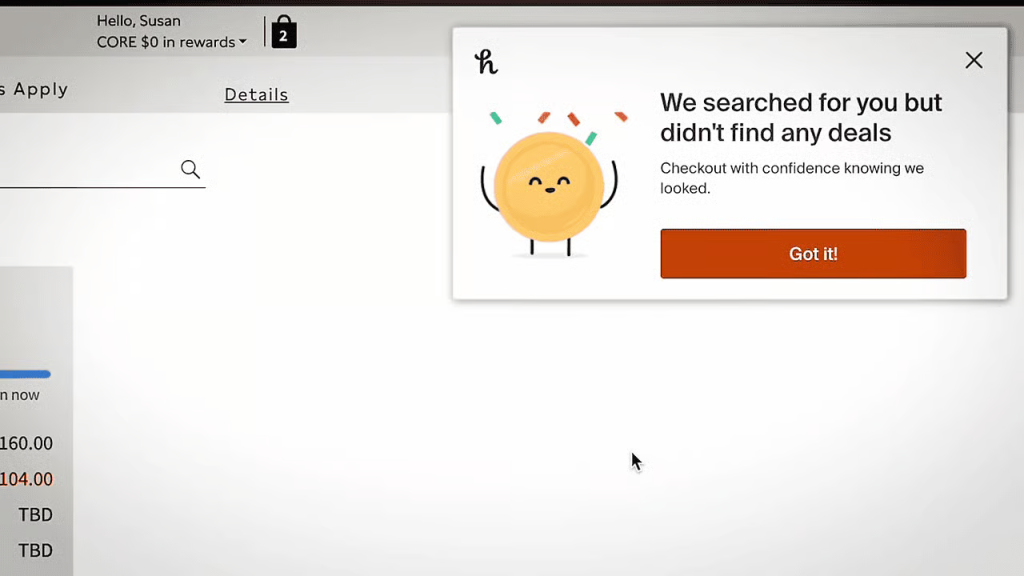
Now do you see why you should care?
Good.
Now let’s talk about what you can do about it.
Takeaway
Look, I know I framed Honey in a rather negative way above. But let’s be clear for a minute — Honey’s not doing anything illegal (from what we’ve seen so far) when it “steals” your affiliate commissions.
Nor are they the only ones doing it. (But I’m still going to keep referring to Honey because, you know, it’s simpler.)
Honey is simply acting according to the structure of the market in which it’s acting. That is, last-click attribution.
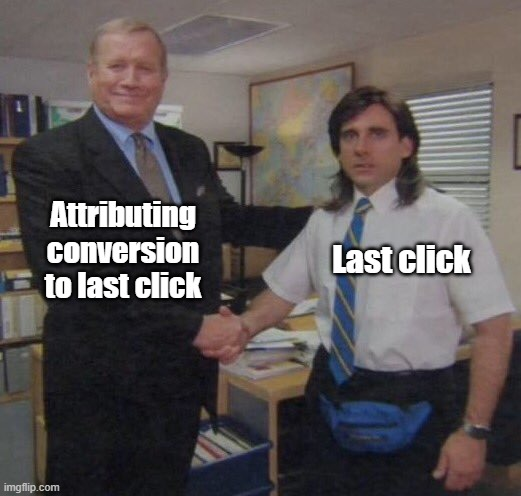
So really, you only have two broad options:
- Fight back within the existing ruleset.
- Fight to have the ruleset changed.
Let’s start with option one — fighting back within the existing ruleset.
First, before you get too carried away, double-check whether your affiliate program is actually using last-click attribution or not. (Chances are, they probably are. There are various “incentive structures” that make this the “natural choice” for most, not the least of which is that it’s the simplest.)
So, let’s say you discover that your chosen affiliate program is working on a last-click basis. Now what?
Well, now you need to see if you’re impacted by Honey. To do that:
- Install Honey.
- Click your affiliate link and take note of your affiliate cookie. (Here’s how to inspect cookies)
- Now proceed to checkout and dismiss Honey’s notification.
- Now take a look at the affiliate cookie again.
- If it changed (and you’re working on a last-click basis, which you probably are), then Honey’s stealing your commissions.
- If your cookie is still there, then you’re fine (for now).
So let’s say you observe Honey replacing your cookie.
What can you do?
Well, honestly, not much. But you might as well fight anyway…
So here are a couple of options.
First, your best bet here is simply to change affiliate programs. That is, find one with the same core product offering where Honey isn’t sniping commissions, and monetize with them instead. Even if they’re paying worse commissions, you might end up better in the end. (But don’t just change by default — sign up with the new program and A/B test for a month or so between programs to see which one’s paying you the most… maybe the original one still works out better, even with Honey sniping some of your commissions.)
That’s one approach.
Another approach — the “I’m in this for the long run, so I actually care about the structure of this industry” one — is to “lobby” any program you work with.
Now, just to be clear here, this probably won’t amount to anything much, so don’t go putting serious effort into this. Here, I’m talking “just get an AI to write you up a quick email you can shoot to your affiliate manager and be done with it” type of effort.
Also, don’t go sending whiny “Honey’s stealing my affiliate commissions, do something about it” emails.
Your affiliate manager probably doesn’t care about you. Nor does their employer.
But you know what they do care about?
Money.
Specifically, their money.
So you fire off a quick email making a business case for them:
- Honey contributes nothing in the way of raising awareness of their brand or driving traffic to their website.
- At best, Honey provides an incremental top-line sales boost owing to increased conversions when it finds a discount code.
- However, the net effect of this should be examined — does, let’s say, a 15% increase in conversion rate actually deliver better bottom-line results when Honey’s not only handing out discounts people wouldn’t otherwise use, but also skimming affiliate commissions off the top of every single transaction a user with the extension installed completes?
- Further, if affiliates earlier in the customer journey (the ones actually doing the real work of building awareness and driving traffic) aren’t seeing results due to checkout-stage sniping, they’re probably going to drop out of the program at some point, or won’t commit as much energy to it.
- Both of those hurt the business in the long run.
And, if you really want to go one step further, promote an alternative model that suits you better (and tell them why it helps them, too).
Now, this doesn’t have to be complicated. In fact, it shouldn’t be complicated. Companies don’t want to go out and build complicated probabilistic multi-touch Markov chain attribution models backed by web-scale data analytics platforms to do their affiliate attribution.

Instead, just suggest a simple “fix”. For instance, maybe they only award partial attribution to any affiliate link clicked within 5 minutes of a customer reaching a checkout.
Simple as that — you get at least some of your commission back. And the business doesn’t kill the incentive for “last-minute conversion boosters” to stop operating. It’s mostly win-win all around (except for Honey… but you’re not Honey, so you should want to hurt them).
Alternatively, if none of that suits your style, there are two final nuclear options.
The first one goes a little like this:
“If you can’t beat them, join them.”

Yep, that’s right. You can always just accept that the last click will always win, and come up with a play that guarantees (or at least increases the odds of) you getting the last click. There are plenty more plays in this last-click game (coupon sites, other browser extensions, you name it…). So you could always take a leaf out of their books.
Alternatively, you could always just sign up with an affiliate program that doesn’t require your referrals pass through a checkout process where discount codes are even a thing to begin with. That way, you’re basically protected for life.
If you need a good example here, think Super Partners.
Closing Thought
With the holiday season being in full flight and all that it entails, I thought it might be a good time to drop a quote or two about the importance of “self-control.”
So to close out this edition (and the year), here are three bangers from some of the greatest thinkers who ever lived.



Now, obviously, self-control isn’t just about not eating too much turkey (too late) and consuming too much booze.
It applies to everything.
Choosing to wake up early to get stuff done rather than sleeping in… doing the “hard work” needed to get stuff done rather than distracting yourself with something else… You get the point.
As for the good news here, not everything that sets you up for success depends on the hard work and disciplined effort needed to attain self-control. If you need a great example of this, ask yourself “how much effort does it take to sign up with Super Partners today?” (Answer: very little.)
__
(Featured image by SevenStorm JUHASZIMRUS via Pexels)
DISCLAIMER: This article was written by a third party contributor and does not reflect the opinion of Born2Invest, its management, staff or its associates. Please review our disclaimer for more information.
This article may include forward-looking statements. These forward-looking statements generally are identified by the words “believe,” “project,” “estimate,” “become,” “plan,” “will,” and similar expressions. These forward-looking statements involve known and unknown risks as well as uncertainties, including those discussed in the following cautionary statements and elsewhere in this article and on this site. Although the Company may believe that its expectations are based on reasonable assumptions, the actual results that the Company may achieve may differ materially from any forward-looking statements, which reflect the opinions of the management of the Company only as of the date hereof. Additionally, please make sure to read these important disclosures.



TopRanked.io Weekly Affiliate Digest: What’s Hot in Affiliate Marketing [Bovada Affiliate Program]
This week, we're mashing up 80s tech with 2020s private messaging apps. Why? Because Big Tech just dropped a big...


Euro Stablecoins Struggle to Compete with Dollar Dominance in Crypto Markets
Euro stablecoins remain marginal despite the euro’s global importance, with minimal trading volume compared to dollar rivals like USDT and...


Gilead Sciences Advances Growth Strategy with Focus on HIV, Oncology, and Innovation
Gilead Sciences focuses on developing treatments for HIV, cancer, and inflammatory diseases, driven by blockbuster drugs like Biktarvy. Growth relies...


Casablanca Stock Exchange Profits Surge in 2025 as Growth Momentum Strengthens
In 2025, Casablanca Stock Exchange profits rose 40% to MAD 50.9 billion. Net income grew 22.3%, driven by strong industrial...


Credibur Scales Rapidly: €2 Billion in Structured Debt Facilities in Six Months
Infrastructure fintech Credibur has added over two billion euros in structured debt facilities within six months. Its platform connects lenders,...
 |
|
 |  |
 |
|
-
 Business1 week ago
TopRanked.io Weekly Affiliate Digest: What’s Hot in Affiliate Marketing [1xBet Affiliate Program]
-

 Crypto4 days ago
Crypto Markets Edge Up as Caution Persists and April Fools’ Scams Loom
-

 Cannabis2 weeks ago
Aurora Shifts Strategy Toward Global Medical Cannabis Markets
-

 Markets6 days ago
Dow Jones Tests Correction Zone Amid Bullish Momentum and Bubble Concerns