Business
Dow Jones Lags Behind Record-Breaking S&P500 Amid Market Divergence
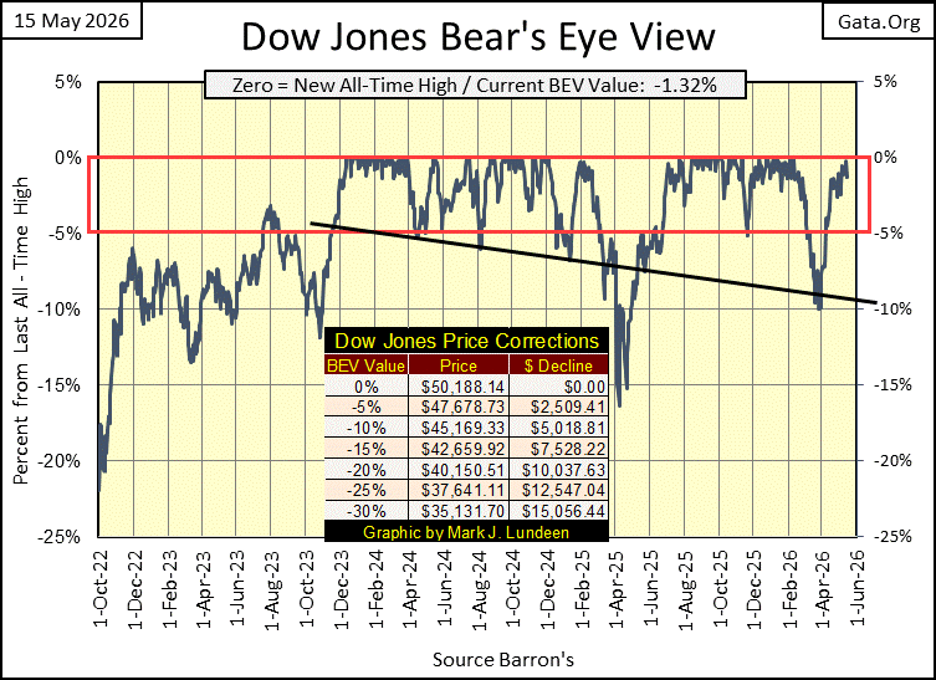
Despite the S&P500 hitting fourteen new highs since April 15th, the Dow Jones lags strangely. Using the Bear’s Eye View, it remains within scoring range at -1.32%, suggesting potential new highs. Resistance near 50,000 persists, but prolonged sideways movement through 2026 or summer is considered highly unlikely. The divergence between indexes remains notable and puzzling.


Again, this week the S&P500, and the big NASDAQ Indexes made not one, but three new all-time highs, as the Dow Jones continues failing to generate a new all-time high since its last on February 10th. What is going on here? This is so bizarre, seeing the S&P500 make fourteen new all-time highs since April 15th, for a month now, as the Dow Jones refuses to rise to the occasion.
What to do? I don’t know. But one nice thing about looking at a market with the Bear’s Eye View (BEV), is the proper thing to assume is; for as long as a market index is in scoring position, within 5% of its last all-time high, you must assume new all-time highs are pending, for as long as its BEV plot remains above its BEV -5% line.
Where did the Dow Jones’ BEV value below, close the week? With a BEV of -1.32%, inside scoring position. So, I see no need to jump out of a perfectly good airplane, just because the Dow Jones is acting very oddly compared to the S&P500 and the big NASDAQ Indexes. Still, I find the market action for the Dow Jones this past month, since April 15th, very odd.
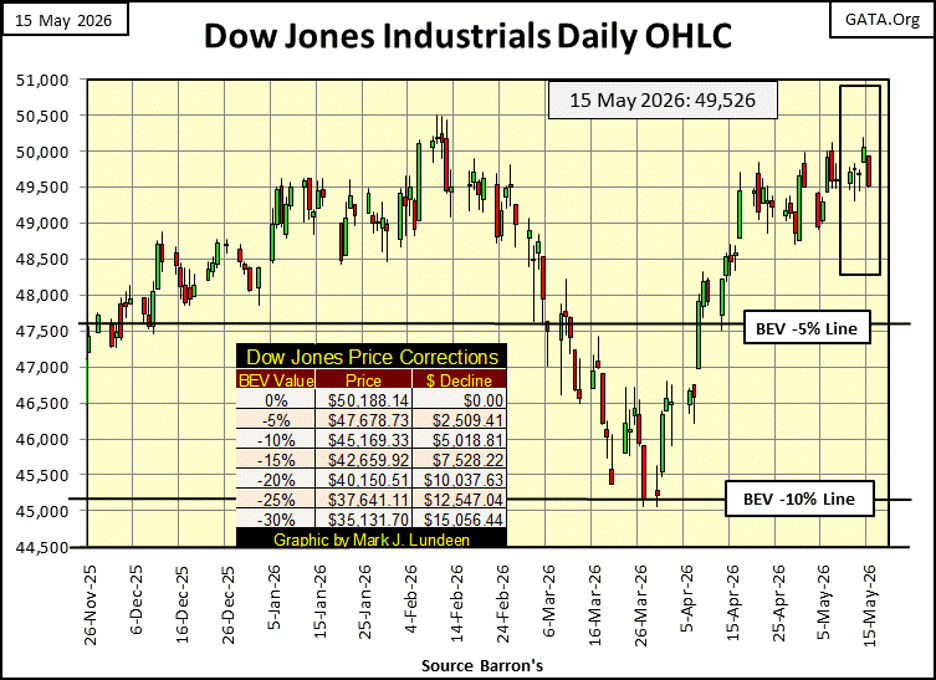
The current last all-time high for the Dow Jones is 50,188. In the chart below, plotting the Dow Jones in daily bars, since February, the 50K line has acted as a very effective line of resistance for the Dow Jones. Maybe, the Dow Jones will trade between its 50K and BEV -5% lines in the chart below, for many years to come. Maybe, but here in the real world, there isn’t a chance in hell the Dow Jones will do that for the rest of 2026, or even to the end of summer.
So, that leaves us with two future possibilities;
• the Dow Jones breaks above its 50K line, and resumes its bull market advance,
• the Dow Jones breaks below its BEV -5% line, and keeps going down.
I’m inclined to believe the Dow Jones will soon resume its advance in the weeks to come. On its way to Dow Jones 55,000 and beyond.
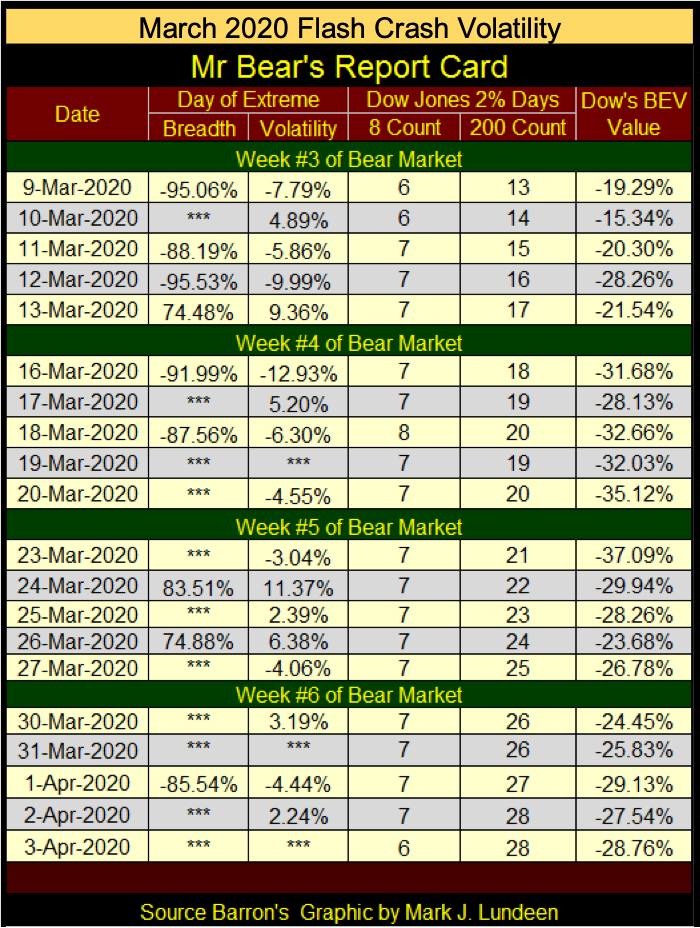
But someday this bubble in the stock market will pop. That is when we’ll see the Dow Jones close below its BEV -5%, then on to its BEV -10% line, and so on and so forth. But – that isn’t going to happen until the Dow Jones once again sees its dreaded Dow Jones 2% days, days the Dow Jones moves +/- 2%, and more from its previous day’s close. Until then, enjoy the ride up.
If you want to know what that will look like, when Dow Jones 2% days will once again dominate the market, below is Mr Bear’s Report Card from the March 2020 Flash Crash. The Dow Jones in early February 2020 was seeing very low daily volatility, up to its February 11th, 2020 last all-time high. Then just a week later, the Dow Jones began seeing daily moves, greatly in excess of 2% from previous day’s closes. When it got really ugly, really soon.
Should (when) the Dow Jones once again sees Days of Extreme Volatility (Dow Jones 2% days), as seen below; don’t walk – but RUN to the market’s nearest exit, before everyone else does.
Here is my table of BEV values for the major market indexes I follow. This week, again the Dow Jones (#6) was a BEV Zero free zone. It came close all this week, but just couldn’t make a new all-time high happen.
There were no BEV Zeros for any of these indexes on Friday’s close. But look at all of the indexes closing the week in scoring position; from #1 to #13. What must we assume for as long as an index closes in scoring position? That new all-time highs are pending.
This week, the XAU (#20) gave back all of the gains it made last week. I don’t like that, but volatility is something investors in the gold and silver miners just has to accept as a fact of life. Don’t be surprised if the XAU is making new all-time highs in the weeks and months to come.
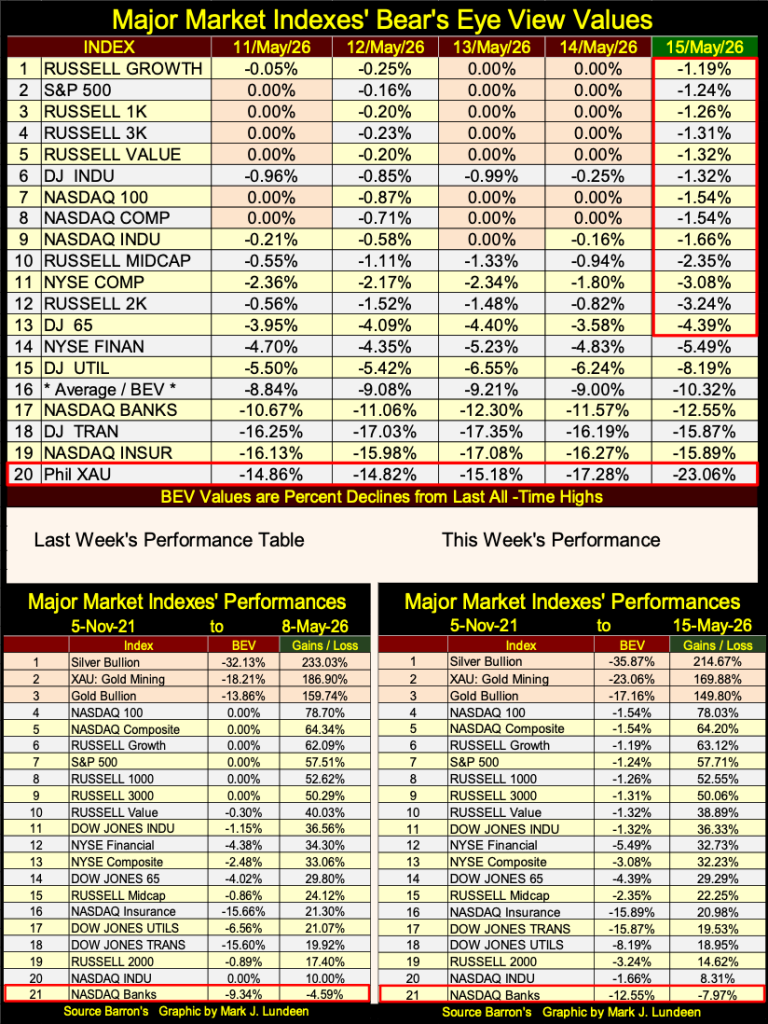
In the market’s performance tables above, the old monetary metals and their miners remained in the top three spots, but saw this week’s largest declines from last week. Sometimes, that is how things go. But nothing has changed for 2026, which I believe will be an excellent year for gold and silver.
I was working on this week’s article, when someone from upstairs shouted down at me, that gasoline is going to be selling for over $7 a gallon by the 4th of July. They heard this on TV, so it must be true, right? I shouted back at them that I’ve heard lots of things in my life, and most of them never came true. Of course I’m talking about the United States. For foreign places like California, or Japan, $7 for a gallon of gas by the 4th of July might be considered cheap.
Looking at the price of crude oil below, it closed the week at $105 for a barrel of crude, which contains 55 gallons of oil. In June of 2022, crude oil was going for over $120 a barrel. What happen in 2022, that made crude oil spike up as it did three years ago? Nothing comes to my mind why the price of crude oil spiked to over $120 for a barrel of oil back then. It had to be something.
We should all note the world didn’t end in 2022, and it won’t end now. Maybe the big difference between now and 2022, is that Biden was president then, and Trump is president now. The usual suspects in the media all liked Biden, as they now hate Trump.
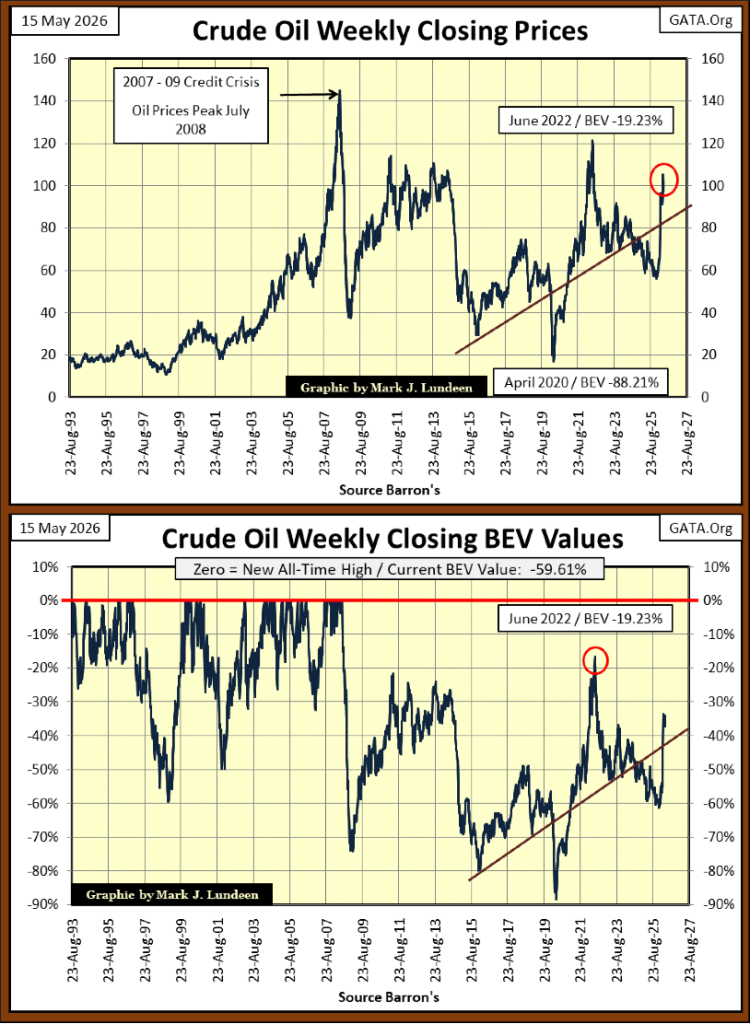
No doubt Trump’s fingerprints are on oil’s price spike seen below for 2026. But if higher fuel prices are the consequences of preventing Iran from becoming a nuclear power, I’m all for it. Thankful Trump is doing the right thing to stop that from happening.
In crude oil’s BEV chart above, the lower the better as far as I’m concerned. I don’t know for a fact, but I wouldn’t be surprised if crude oil was once again trading below its BEV -60% line before 2026 is over. Or even by America’s November 2026 election day, exactly as happened in 2022, another mid-term election year in the United States. Funny how some things always seem to go.
Something more alarming than the spike in crude oil prices seen above, is seeing this T-bond’s yield below closed this week above 5%, at 5.24%. This data, as is the price of crude oil above, is weekly. Thursday’s closing price for crude oil above, Friday’s closing data for the T-bond below. Its previous high yield was at 5.19%, back in October 2023.
Remember, rising bond yields = declining bond prices. Are we looking at the resumption of the bond-bear market that began in August 2020? If so, the stock market ultimately will suffer for it, but the old monetary metals, gold, and silver, and their miner will benefit in due time, if not this week.
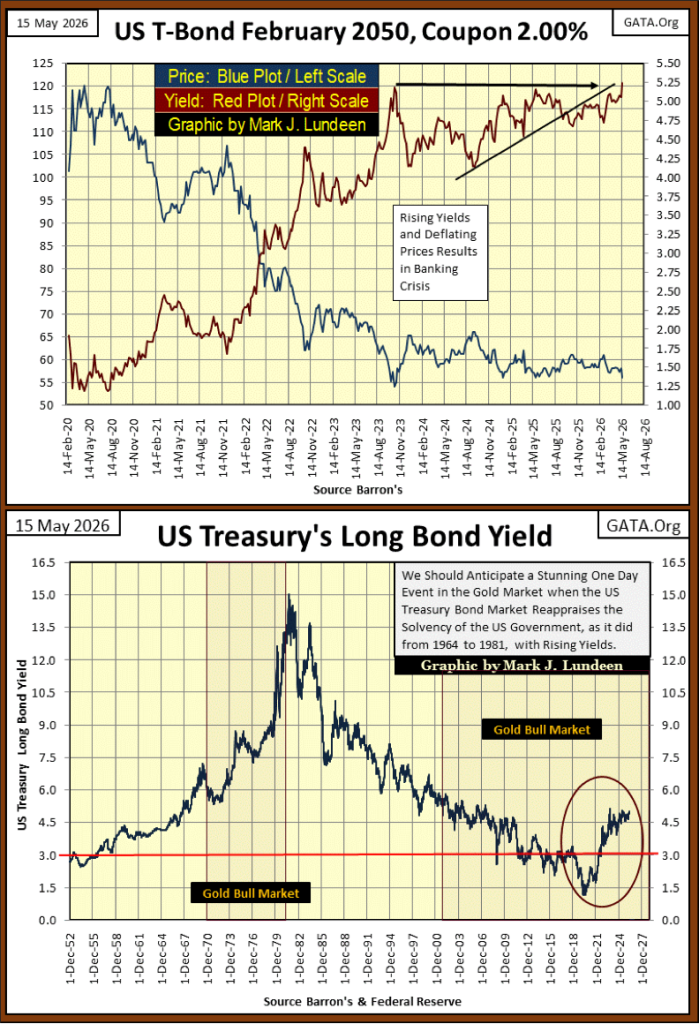
I’m publishing a long-term chart on the US Treasury’s Long Bond Yield, going back to 1952 above. Reading it is easy;
• Rising Yields = Bond Bear Market, and Rising CPI Inflation,
• Declining Yields = Bond Bull Market, and Wall Street dances in the street.
No one is talking about it – YET – but the bond market entered a bear market in August 2020, when yields bottomed, and began advancing again. This week to a yield of 5.02% for the 30yr T-bond. That is a huge jump in yields since August 2020, when the yield for the 30yr T-bond bottomed at 1.20%.
It’s not just the T-bond market seeing current yields rise. Corporate bonds too are in a bear market that no one is talking about, and as seen below, have seen their yields rise since 2020.
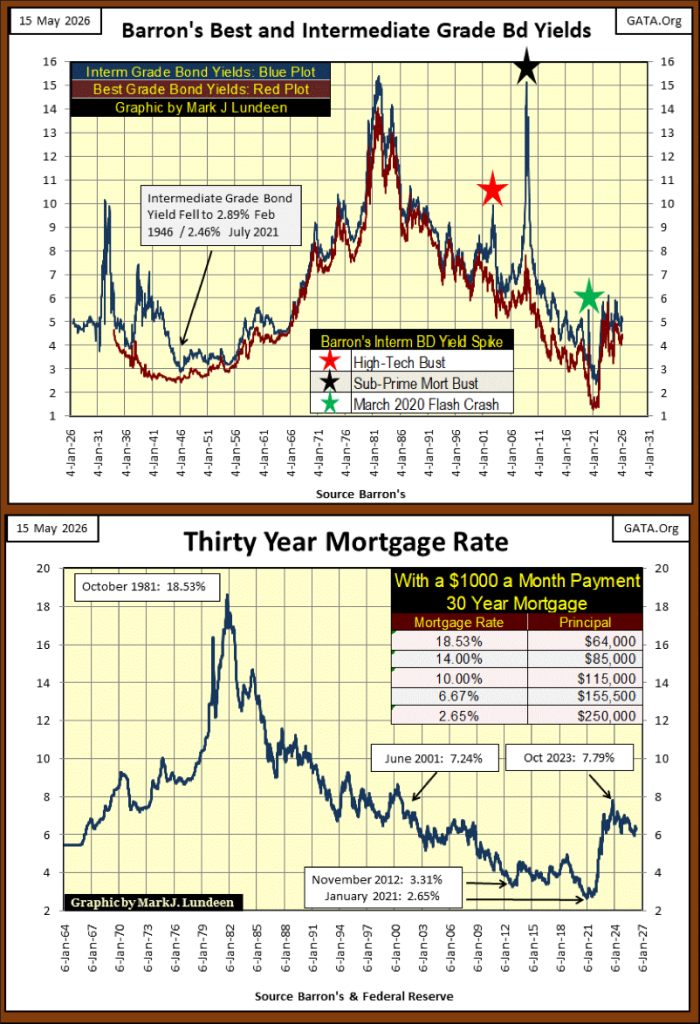
Mortgage rates are rising too (chart above), and have been since January 2021. Housing price inflation may still be happening. But should mortgage rates exceed, oh I don’t know, maybe 8%, and stay there, we’ll see another real estate crisis.
Rising bond yields and mortgage rates will prove to be the pins that pricks the bubble in the stock market, if nothing else does before.
Let’s change the subject, as April and May are simply wonderful. After a winter of snow and cold, it’s so nice when days grow longer, the sun becomes warmer, and once again the world I live in is leafy green. What about all the flowers blooming? Please, don’t get me started about the pretty dandelions and lilacs!
It’s not just me who feels this way about this time of year. Below, is a 12th century quote from a vassal of England’s King Henry II, what spring did to him 900 years ago.

I know what you ladies are thinking out there; “men – they’ll never change!” However, in defense of my gender, in the past, as it is today, mothers have a huge impact on the worldview of their baby boys. Here is the medieval chronicler – Fredegar, from the 7th century, recording a mother’s advice to her son.

Good grief! We should feel fortunate not living in such a barbaric time and place, as Europe from 400 to 1500. But then again, the elite in our world are much more sophisticated when dealing with the little people, to get what they want from us, which, as it was centuries ago, is as much as they can, anyway they can.
Today, our elite have little desire to “walk with death, with fire and sword in hand.” Rather, they offer the peasants “loans and mortgages at attractive rates,” so we can consume more than our means would allow, and we thank them very much for it.
Because that is what the global central banking cartel, which includes the Federal Reserve System does; it swaps everyone’s equity, with the central bank’s liabilities. As soon as the Federal Reserve System was legislated into existence in 1913, money of gold and silver was doomed. As was price stability, in consumer goods and financial assets.
Long ago, President Jackson killed the Second Bank of the United States in 1836, because he understood exactly that. Jackson scared everyone in Washington. He was a duelist, and hated paper money. He would have publicly denounced the scoundrel who placed his image on the US $20 Federal Reserve Note as a “poltroon,” and called him out, on to the field-of-honor for a duel.
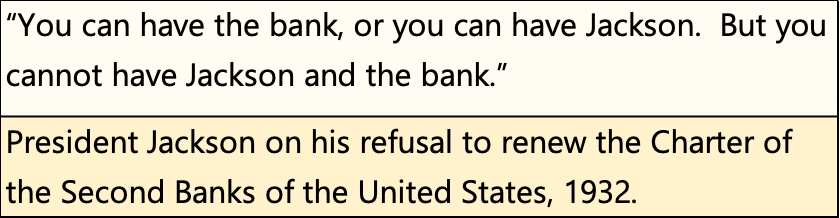
In the 1832 presidential election, the voters chose Jackson over the bank. Jackson did not renew the Second Bank of the United States’ charter in 1836.
A historical item I find interesting about President Jackson; in a duel he won, he received a bullet that was lodged next to his heart, a bullet he lived with for many decades. Jackson was someone no one wanted to cross, as doing so may cost one their life.
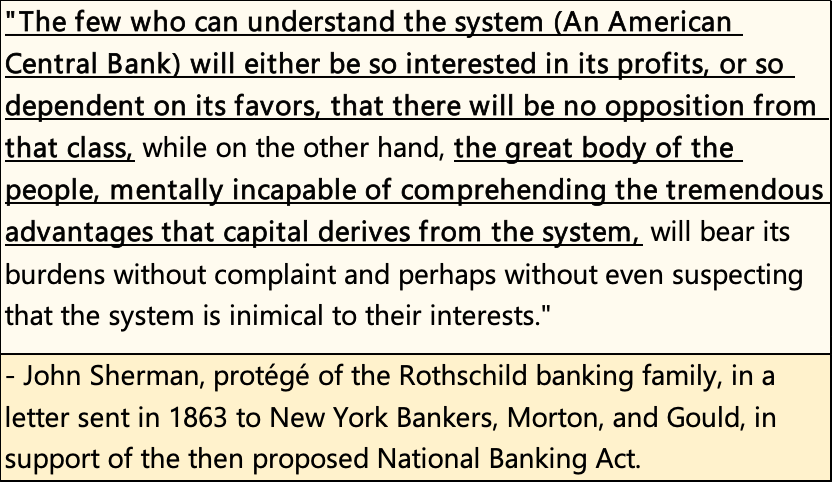
There was always someone who wanted a central bank, as seen during the American Civil War below.
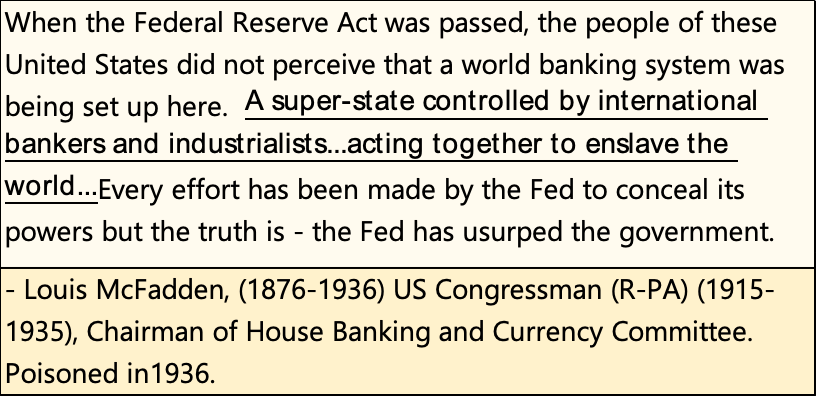
The Federal Reserve System itself, was legislated into existence in 1913. Below are comments about the Federal Reserve System by Louis McFadden, a Congressman from Pennsylvania, who passed away under suspicious circumstances in 1936.
Okay. All this historical background is nice to know. But Mark, this week, what is it that is really bothering you about the idiots at the FOMC now?
I can’t find the link, but on local news this past week, I saw a news video about an elderly couple who came home to discover their bank had sent a locksmith to change the locks on “their home,” because they fell behind on the insurance on “their home.” As it turned out (as is always the case), any home with a mortgage, is always the bank’s house. The “homeowners” who service the home’s mortgage, are allowed to live there, only if they pay their monthly mortgage bills, and I guess if they also keep the home’s fire insurance up to date.
This sounds a little odd to me, as home insurance for a mortgaged home is typically included in the escrow for the home. To pay for rising insurance costs, banks do increase a “homeowner’s” mortgage’s monthly payments.
Now my problem with that is, and I’ll use my home as an example, the idiots at the FOMC have been very busy swapping my home’s equity, with their liabilities for the past three decades, without my approval. So much so, in the past thirty years the county has increased the market valuation for my home from $45,000 to $165,000, just because the idiots can’t restrain themselves from “injecting liquidity” into the real estate market.
Of course, my property taxes have increased accordingly, how could they not? So too has the cost of insurance on my little home; a $165,000, one bedroom, one bath estate, in a very working-class neighborhood.
My neighbors, and family members think they’re getting rich “owning” their homes. They aren’t. But don’t tell them that, as doing so only makes them very angry!
What’s actually happening is; via monetary inflation, the “monetary system” is squeezing as much juice out of these turnips as they can, and they don’t give a damn about the lives they are destroying. What did John Sherman above say in 1863?

John Sherman may have been a Son-of-a-Bitch, but a SOB who understood central banking and people. He wasn’t someone who was inclined towards showing the mass of humanity any mercy. I’m sure in the latter half of the 19th century, he did just fine on Wall Street, and in Washington DC.
Here is gold’s BEV chart. Last week, I was hoping it would continue rising, breaking above its BEV -10% line. Instead, it went the wrong way, closing the week below its BEV -15% line.
Maybe, this correction in gold is going to be a 20% correction, or more. However, when we look at gold’s step sum table below, at all the down days gold has seen these last five trading weeks, the bears in the gold market must be close to becoming exhausted in their selling. It’s just one down day after another, for months now, and that can’t go on forever.
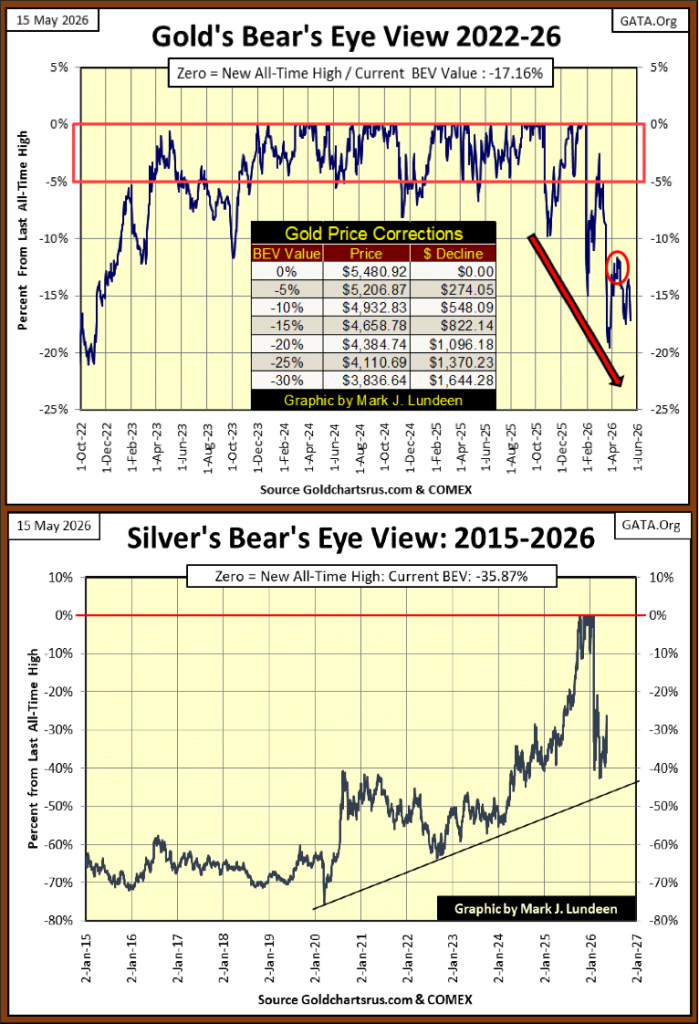
Here is silver’s BEV chart above. From November to January, silver saw twenty-six daily BEV Zeros, its first new all-time highs since January 1980.
From November 26th, to January 28th, forty-one trading days, silver saw twenty-six new all-time highs, for 63.4% of these forty-one trading days. Then silver loses 40% of its valuation in a matter of days. Something is not right about that. But if you liked silver at $118 on January 28th, you have to love it at $76 at the close of this week.
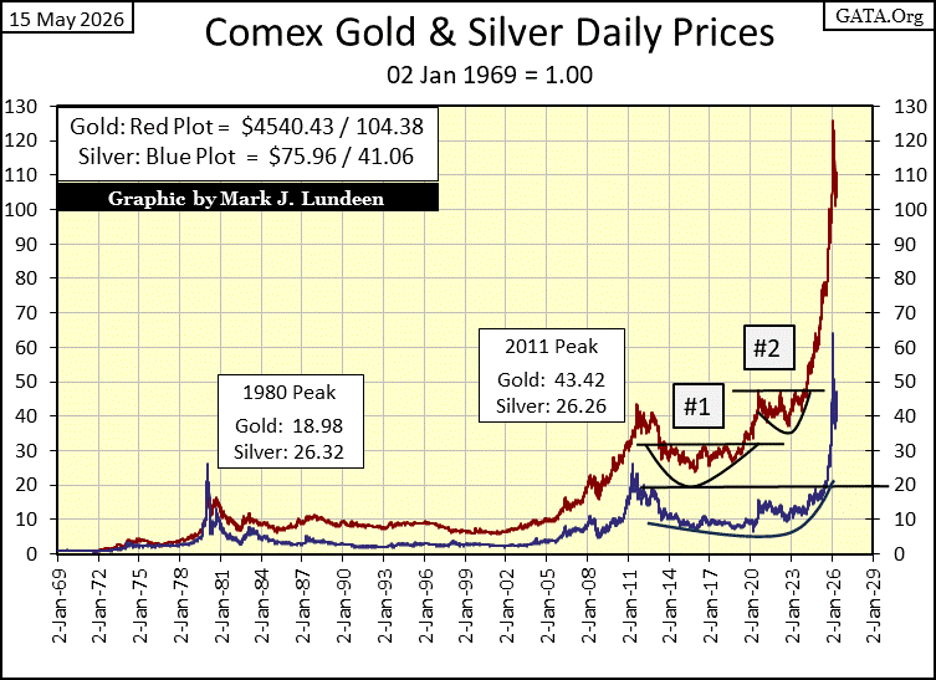
Keep in mind the gains the old monetary metals have seen in the past year, chart below. Corrections in these plots are only to be expected, and they are temporary. Just how temporary I can’t say. But sometime this summer, I expect gold and silver will once again be generating new all-time highs.
Here is gold’s step sum table below. Geeze Louise, look at all of those red daily declines in the price of gold since April 13th! Gold’s 15-count closed the week with a -5. Not an oversold market, as it would be if its 15-count closed the week with a -7, or deeper count.
But gold’s 15-count has been negative since March 13th, for two months now. And from March 20th to March 27th, gold’s 15-counts were -7s and -9s, and a -9 15-count is a very oversold market. Looking at gold’s 15-count legion table below, seeing the gold market with a 15-count of -7 or -9, are infrequent, extreme market events.
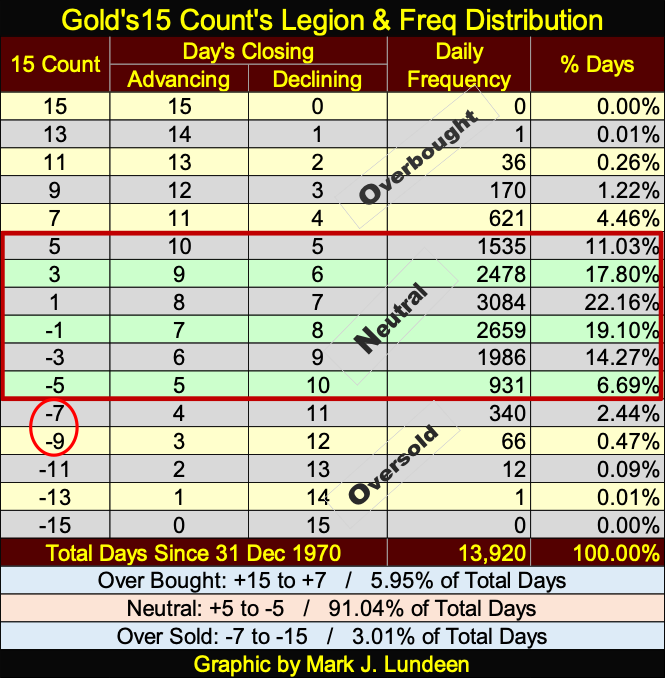
A 15-count of a -7 or a -9 typically marks a market bottom, that the market is due for rising prices, but not last March. One thing for sure, it took a lot of selling for all of these down days in the price of gold in these past two months.
At this week’s close, the bears in the gold market have driven the price of gold down by only 17.16% from its last all-time high seen on January 28th. To me, that seems like a lot of work for the small gains, or losses in the price of gold the bears have worked so hard to achieve since January.
It’s been four months since gold’s last all-time high. The bears have to be getting tired. I think the next four months, will not look like the past four months.
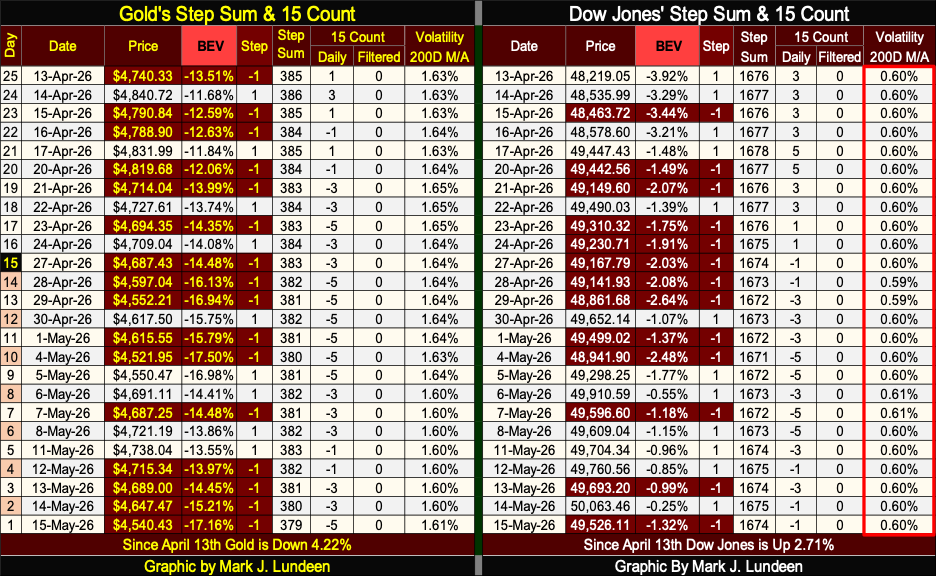
On the Dow Jones’ side of the step sum table above, in April it too saw some selling, down days overwhelming advancing days. Look at that block of five continuous down days in late April, that took the Dow Jones’ BEV from -1.39% to -2.64%. Not much of a loss for all that selling!
Then, the next day (April 30th), an advancing day that took the Dow Jones BEV up to -1.07%. One day wiped out the losses of the previous five days, and then some. Things like that happen in bull markets.
Look at the Dow Jones’ daily volatility’s 200D M/A; mostly 0.60%, day after day. For as long as the Dow Jones daily volatility remain that low, I’m expecting the Dow Jones (my proxy for the broad stock market), will continue advancing. Dow Jones closing over 55,000 sometime in 2026? Unless we begin seeing the dreaded Dow Jones 2% days become regular occurrences in the market, 55,000 on the Dow Jones is very possible, maybe even likely by this Christmas.
__
(Featured image by Markus Spiske via Unsplash)
DISCLAIMER: This article was written by a third party contributor and does not reflect the opinion of Born2Invest, its management, staff or its associates. Please review our disclaimer for more information.
This article may include forward-looking statements. These forward-looking statements generally are identified by the words “believe,” “project,” “estimate,” “become,” “plan,” “will,” and similar expressions, including with regards to potential earnings in the Empire Flippers affiliate program. These forward-looking statements involve known and unknown risks as well as uncertainties, including those discussed in the following cautionary statements and elsewhere in this article and on this site. Although the Company may believe that its expectations are based on reasonable assumptions, the actual results that the Company may achieve may differ materially from any forward-looking statements, which reflect the opinions of the management of the Company only as of the date hereof. Additionally, please make sure to read these important disclosures.















Ecobnb Turns Sustainable Tourism Into Measurable Impact
Ecobnb’s sustainable tourism platform generated significant environmental and social impact in 2025, avoiding 58,207 kg of CO₂ and adding 583...


Sugar Markets Balance Biofuel Demand and Global Supply
Sugar markets in New York and London were mostly unchanged as the Iran conflict renewed interest in biofuels. Drought concerns...


The $40 Trillion Trap: Disinflation Is Not Deliverance
U.S. debt has reached $40 trillion, with $24 billion weekly interest, while deficits accelerate. Despite disinflation in CPI, from cooling...


FinTech Matures as AI and Infrastructure Drive the Next Growth Phase
Fintech markets are entering a mature phase, shifting from rapid growth to consolidation, specialization, and sustainable business models. Zurich and...


Bitcoin, and Ethereum Rise, While Cardano Enters Transition
Bitcoin and Ethereum posted modest weekend gains, supported by ETF inflows. A new proposal may protect Bitcoin from quantum threats....
 |
|
 |  |
 |
|
-

 Crowdfunding2 weeks ago
Lemonaid Offers Shares to Consumers for the First Time
-

 Crypto5 days ago
Bitcoin’s Price Drops as Investors Turn to Layer 2 Solutions
-
 Markets2 hours ago
Sugar Markets Balance Biofuel Demand and Global Supply
-

 Crowdfunding2 weeks ago
East Crema Coffee Launches €3.5M Crowdfunding Campaign